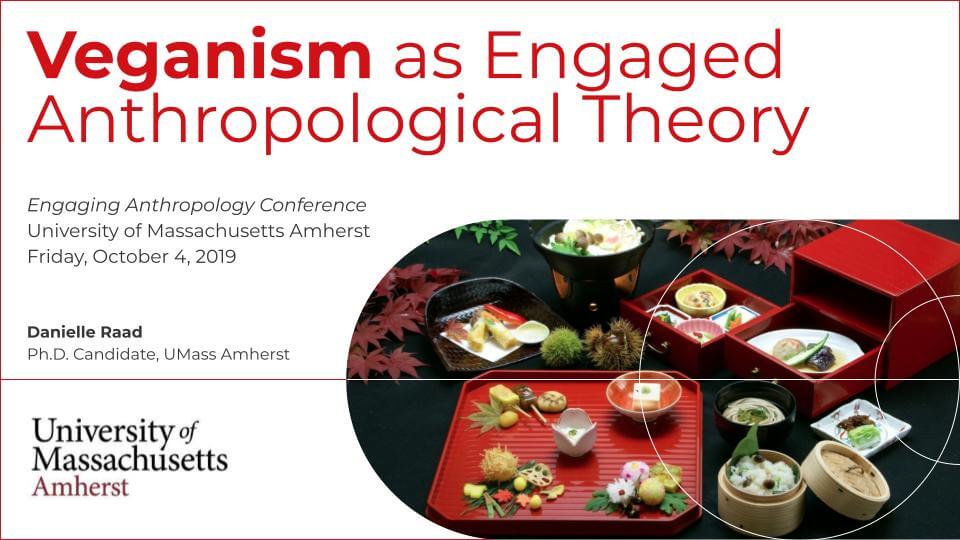
I organized, chaired, and presented in a session called “Veganism as Engaged Anthropological Theory” at the Engaging Anthropology Conference. The conference was convened in celebration of the 50th anniversary of the University of Massachusetts Amherst Anthropology Department and held in Amherst on October 3-6, 2019.
Veganism as Engaged Anthropological Theory
Session Description
Veganism as Engaged Anthropological Theory
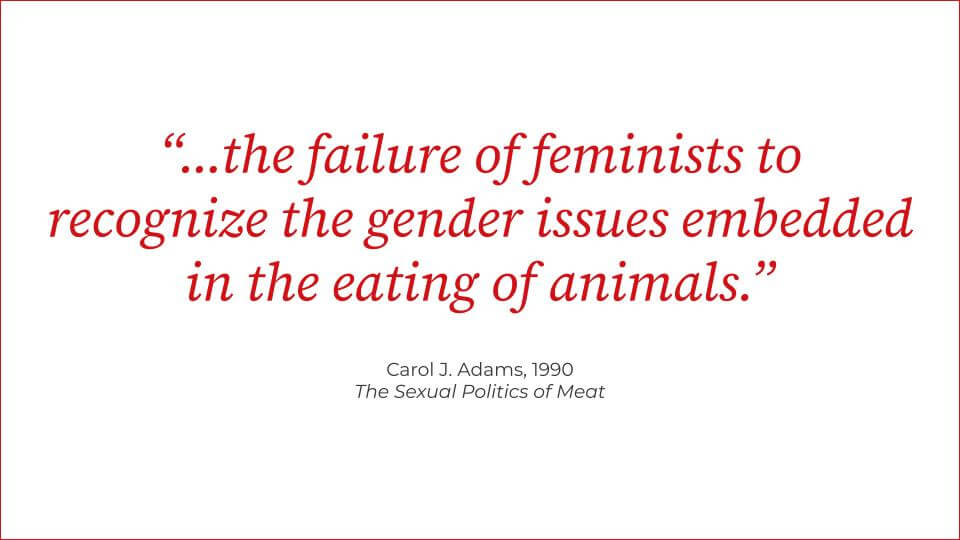
Human domination over all global systems in the anthropocene has impacted nonhuman animal lives in diverse and wide-reaching ways. Carol J. Adams, through her feminist-veg critical theory, has exposed the “sexual politics of meat” and its ongoing perpetuation by the patriarchy. The meat and dairy industries are sustained by reproductive control and the objectification of female bodies. In addition, the increasing quantity of meat eaten in the United States is a runaway byproduct of the ideological legacies of colonialism and imperialism. The papers in this session take ecofeminist, anti-capitalist, and zoocentric perspectives to explore how veganism can be a performative feminist and de-colonizing stance that rejects and bears witness to both human and nonhuman animal injustices.
Talk Description
An Unpolished Mirror: Nonhuman Animals in the #MeToo Era
“We polish an animal mirror to look for ourselves,” Donna Haraway wrote in 1978 of humans’ tendency to study animals, particularly primates, in order to better understand ourselves. These biological, scientific studies seek to elucidate the reproductive and social behaviors of humans. But the ways that humans treat other animals, in the context of scientific testing as well as the dairy and meat industries, parallel behaviors and mentalities that we are increasingly recognizing as problematic in our interactions with each other. The widespread objectification and exploitation of female bodies, at the forefront of discourse in the current #MeToo era, is unsettlingly reproduced and reinforced in interactions with nonhuman females. I seek to polish this largely fogged mirror by analyzing the language around concepts such as consent and entitlement, exploring the potential of a vegan theoretical lens to move towards universal gender equality.
Other Talks in the Session
Koosje de Pooter, Executive Producer, Tangerine Tree
“Is Milk Good for Everyone? An Ecofeminist Exploration of the Dutch Dairy Industry”
Suzanna Powers, Leipzig University
“Vegetarian Japan: The Contemporary State of a Historical Diet”
Kasia Preski-Enriquez, Undergraduate, Lewis & Clark College
“Factory Farming and the Unspoken Intersections of the Vegan Movement: An Anti-Capitalist and Activist Perspective”
Dr. Anna Taylor, Associate Professor of History, University of Massachusetts Amherst
“Towards Zoocentric History: Why Animal History Matters”