Using X-ray diffraction and digital optical microscopy, I investigated the materials and manufacturing techniques used to produce stone beads at the Neolithic site of el-Hemmeh in Jordan. This research revealed changing preferences in color and raw materials over time while demonstrating remarkably consistent production methods, shedding light on the social and symbolic worlds of early farming communities.
Back to all Writing
Writing
Application of X-ray Diffraction and Digital Optical Microscopy to Investigate Lapidary Technologies in Pre-Pottery Neolithic Societies
Abstract
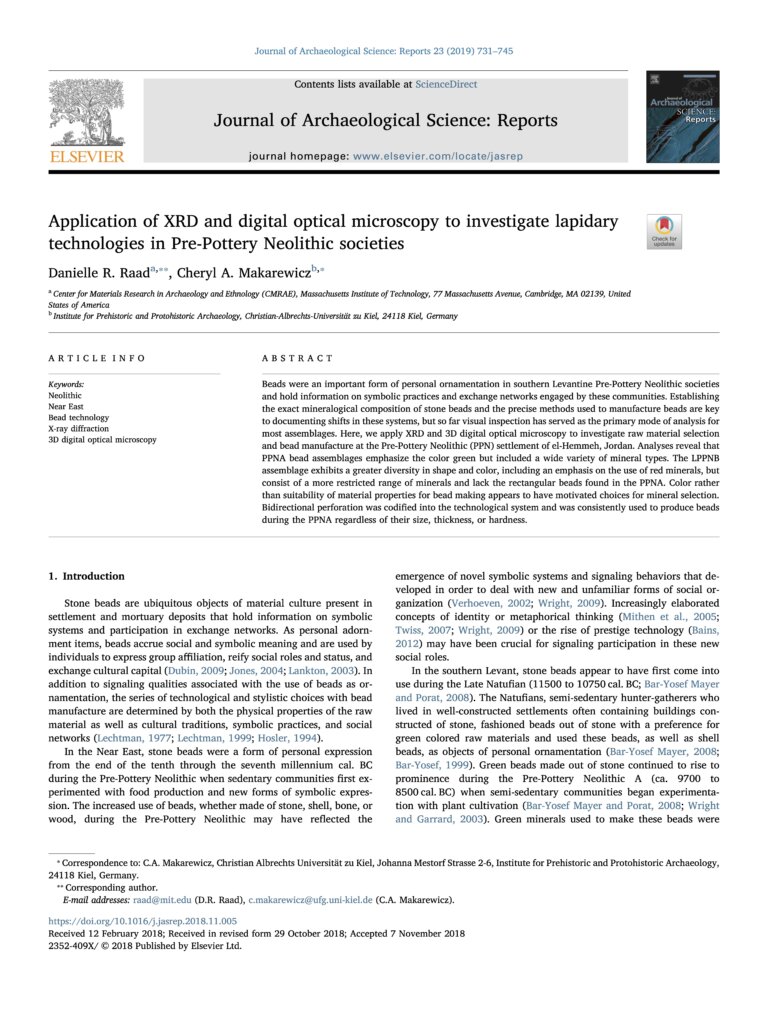
Beads were an important form of personal ornamentation in southern Levantine Pre-Pottery Neolithic societies and hold information on symbolic practices and exchange networks engaged by these communities. Establishing the exact mineralogical composition of stone beads and the precise methods used to manufacture beads are key to documenting shifts in these systems, but so far visual inspection has served as the primary mode of analysis for most assemblages. Here, we apply XRD and 3D digital optical microscopy to investigate raw material selection and bead manufacture at the Pre-Pottery Neolithic (PPN) settlement of el-Hemmeh, Jordan. Analyses reveal that PPNA bead assemblages emphasize the color green but included a wide variety of mineral types. The LPPNB assemblage exhibits a greater diversity in shape and color, including an emphasis on the use of red minerals, but consist of a more restricted range of minerals and lack the rectangular beads found in the PPNA. Color rather than suitability of material properties for bead making appears to have motivated choices for mineral selection. Bidirectional perforation was codified into the technological system and was consistently used to produce beads during the PPNA regardless of their size, thickness, or hardness.
Keywords
Neolithic; Near East; Bead technology; X-ray diffraction; 3D digital optical microscopy